
Setting boundaries can sound simple in theory, but in practice it can bring up guilt, anxiety, or fear of disappointing others.
For many people, the challenge is not knowing what boundary they need. It is allowing themselves to have that boundary without feeling selfish or responsible for how others react.
Learning to create healthy boundaries can help protect your time and emotional energy, reduce resentment, and support healthier relationships.
What Are Healthy Boundaries?
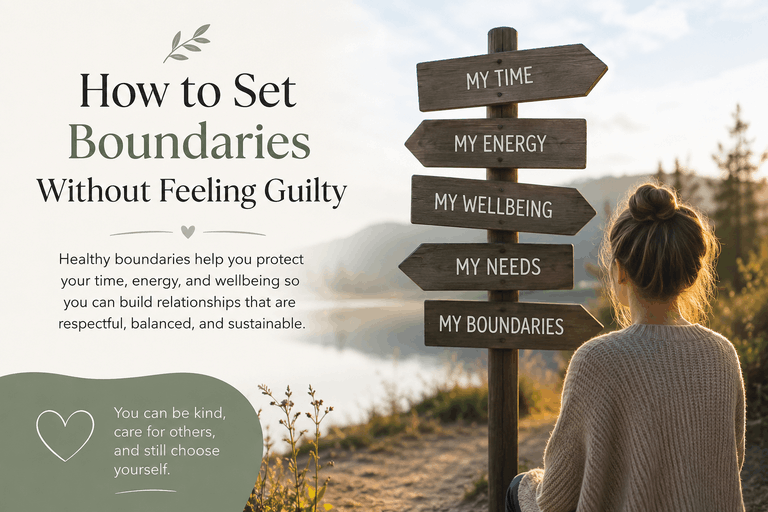
Boundaries are the limits you set around what you are comfortable with, what you are willing to do, and how you expect to be treated.
They can involve your:
- Time and availability
- Emotional energy
- Privacy and personal space
- Work responsibilities
- Relationships
- Values and beliefs
A boundary might sound like:
I can’t stay late tonight, but I can help tomorrow.
Or:
I’m not comfortable discussing that.
Healthy boundaries are not about controlling another person’s behavior. They are about communicating what you will and will not participate in, and deciding how you will respond when your limits are crossed.
Why Do I Feel Guilty When I Set Boundaries?
Guilt does not always mean you are doing something wrong.
If you are used to being helpful, accommodating, or avoiding conflict, saying no may feel uncomfortable even when your boundary is reasonable.
You may worry about:
- Disappointing someone
- Being seen as selfish
- Creating conflict
- Hurting someone’s feelings
- Losing a relationship
Sometimes guilt simply reflects that you are doing something new.
How to Set Boundaries Without Feeling Guilty
1. Identify What You Actually Need
Instead of thinking, “My family stresses me out,” try to identify what specifically feels difficult.
Maybe you need fewer calls during work hours, more notice before plans, or less discussion about certain personal topics.
Clear boundaries are easier to communicate than vague frustration.
2. Pause Before Saying Yes
If you often agree to things and regret them later, give yourself time before responding.
Try saying:
Let me check my schedule and get back to you.
This gives you space to decide based on your actual capacity instead of pressure in the moment.
3. Keep Your Boundary Simple
You do not always need a long explanation.
You can say:
I won’t be able to come tonight, but thank you for inviting me.
Or:
I can’t take on another project right now.
A respectful no does not require an elaborate justification.
4. Accept That Someone May Be Disappointed
You can communicate respectfully and someone may still feel disappointed.
Their disappointment does not necessarily mean your boundary is wrong.
Part of developing healthy boundaries is recognizing that you can care about someone’s feelings without taking full responsibility for them.
5. Ask Whether the Guilt Fits the Situation
When guilt appears, ask yourself:
Did I actually do something harmful, or did I simply do something someone else did not prefer?
If you were disrespectful, you can address that. But if you calmly declined something because you did not have the time, energy, or willingness, the guilt may be connected to old patterns rather than wrongdoing.
6. Follow Through
Communicating a boundary is only part of the process.
If you say:
If the conversation becomes disrespectful, I’m going to take a break.
Maintaining the boundary means actually stepping away when necessary.
Consistency helps others understand your limits and helps you build confidence in maintaining them.
What If Someone Says My Boundary Is Selfish?
If you have always been the person who says yes, changing that pattern may be uncomfortable for people around you.
That does not automatically make the boundary unhealthy.
Ask whether your boundary is:
- Respectful
- Reasonable
- Consistent with your values
- Focused on your own actions
- Intended to protect your wellbeing rather than punish someone
Healthy boundaries consider both your needs and the fact that other people have needs and boundaries of their own.
Examples of Healthy Boundaries
With family:
“I’d rather not discuss that today.”
With friends:
“I want to be there for you, but I don’t have the energy for a long conversation tonight.”
At work:
“I can complete this by Friday. If it needs to be done sooner, we’ll need to adjust my other priorities.”
With a partner:
“I want to talk about this, but I need some time to calm down first.”
Boundaries can be kind, respectful, and firm at the same time.
When Setting Boundaries Feels Especially Difficult
For some people, difficulty setting boundaries is connected to people-pleasing, fear of conflict, anxiety, family expectations, or past relationship experiences.
You may understand intellectually that you are allowed to say no while still feeling intense guilt when you try.
Therapy can help you explore why setting boundaries feels difficult, identify unhealthy relationship patterns, and develop communication strategies that fit your circumstances.
If you are looking for therapy in Coquitlam, counselling can provide a supportive space to explore boundary-related guilt and learn how to establish healthy boundaries without constantly feeling responsible for other people’s reactions.
You Can Be Kind and Still Have Boundaries
Setting boundaries does not mean pushing people away.
You can care about someone and still say no.
You can understand someone’s feelings without taking responsibility for fixing them.
You can ask for space, change your mind, and protect your time and emotional wellbeing.
Healthy boundaries allow relationships to exist without requiring you to repeatedly ignore your own needs.
Looking for Therapy in Coquitlam?
At Linanna Therapy, we provide therapy in Coquitlam for individuals experiencing anxiety, stress, relationship difficulties, people-pleasing, and challenges with setting healthy boundaries.
Therapy can help you better understand your needs, communicate them more confidently, and develop healthier patterns in your relationships. Book your appointment HERE.